← Back to FLSEMI Products & services · DECT NR+

Bring your device to the DUT position.

If you are developing or integrating a DECT NR+ device and need it brought up, characterised or run against controlled interference, we take the work on as a paid engagement — on the same bench and by the same method we use for our own stack.

Mutual NDA before any design material Staged payment Acceptance review Schedule after inspection
DUTYour position
NDAMutual, signed first
StagedDeposit & balance
SWDRequired on your board
FloridaShip to Kissimmee
Before anything else

Know what you are buying

What makes this worth paying for is the method, not the room. How we take ETSI TS 103 636 apart clause by clause, how the bench is arranged, and what we do and do not claim about our own stack are all set out on the technology page — read that first if you have not.

See how we build and verify the stack →

Engineering services

How an engagement runs

Nine steps, in this order. Two of them exist so that you can judge the work rather than take it on trust — one before you commit, one before the balance falls due.

Enquiry

Tell us what the device is, what state it is in, and what you need to know at the end. The form at the foot of this page reaches us directly — select DECT NR+ Engineering Services.

See the work first

Before you commit to anything, we can show you a recorded bench run on our own hardware — the link, the injected interference and what the monitor captured — and, where it is useful, put a physical sample in your hands. You should be able to judge the standard of the work before you sign, not after.

Mutual NDA

Before any design material changes hands we sign a mutual non-disclosure agreement. Your schematics, firmware, documentation and anything we observe about your implementation are held in confidence and are not used outside your engagement.

Scope and quotation

We agree what will be measured, what will be delivered and what it costs, and put it in writing. Nothing starts before the scope is written down.

Deposit

We issue an online payment link for a deposit against the agreed quotation. The balance is not due until the acceptance review below. The split is set in the quotation rather than fixed here, because it follows the shape of the work.

Ship the hardware

Send the device to our office in Kissimmee, Florida. Include enough units to close a link — a single board can be probed, but it cannot be observed communicating.

Incoming inspection and schedule

We inspect what arrived, confirm we can reach it and start it, and only then issue a schedule. We do not commit to a delivery date before the hardware is in front of us, because the honest answer depends on what we find when we open the box.

Bring-up and measurement

Your device takes the DUT position on the bench, with the reference peer, the interference source and the passive monitor arranged around it exactly as described on the technology page.

Acceptance review

You receive the recorded test runs, the results and the returned hardware, and you review them against the agreed scope before the balance falls due. Acceptance is measured against what we agreed to do — not against a result nobody could promise in advance, because “the design has a problem here” is a successful engagement even when it is unwelcome news.

What your board must expose

One connector decides whether we can start on day one

Everything else can be worked around. Debug access cannot. Lay out a standard Arm Cortex Debug header and our probe cable plugs straight in; leave it off and the first days of the engagement go into fixturing instead of measurement.

Debug connectorRequired. 10-pin Arm Cortex Debug header, 1.27 mm (0.05″) pitch — the same footprint carried on standard nRF development kits, so our test lead mates without an adapter.
SignalsSWDIO and SWCLK as a minimum. SWO on pin 6 if you want trace output; nRESET on pin 10 makes recovery far less painful.
Reference voltagePin 1 (VTref) must be driven from your board's own I/O rail. The probe reads that level and shifts SWDIO / SWCLK to match — it never forces a level onto your device. Do not leave pin 1 floating, and do not tie it to a rail that is not the I/O voltage the debug pins actually sit on.
Voltage range1.2 V – 5.0 V at VTref. 1.8 V and 3.0 / 3.3 V I/O are routine. If your rail is below 1.8 V, or if the I/O voltage is switched at runtime, tell us before shipping.
GroundPins 3, 5 and 9 all tie to board ground. Pin 9 (GNDDetect) is how the probe knows a target is attached — leave it unconnected and the connector reads as empty.
Board powerThe debug connector does not power your board. Send the supply with it, and tell us if the device needs a particular start-up sequence or USB power profile.
OrientationKeyed shrouded header preferred. If the footprint is unshrouded, silkscreen pin 1 clearly.
Serial consoleStrongly recommended. A UART brought out to pin header or USB shortens almost every debugging loop.
RF accessA connectorised RF path is welcome but not required. Where only an integrated antenna exists, we test it as the product actually radiates.
QuantityAt least two units, so a link can be formed and observed rather than inferred from one endpoint.
Ship withPower supplies, cables, any programming fixture that is not standard, and a note on how the device is meant to be started.
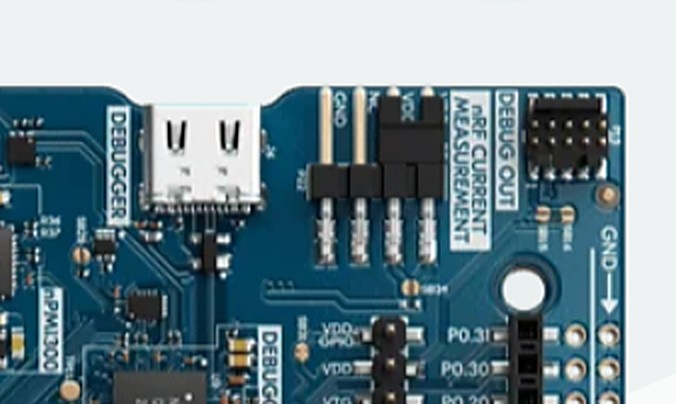
A 10-pin 1.27 mm Arm Cortex Debug header on a development board, silkscreened DEBUG OUT
The connector we mate to — the 10-pin 1.27 mm header at top right. This is a development kit; the same footprint on your board is what we need.
10-pin · 1.27 mm pitch key / polarising slot at top 1 VTref 1.2 – 5.0 V 2 SWDIO 3 GND 4 SWCLK 5 GND 6 SWO 7 key 8 NC 9 GNDDetect 10 nRESET

Signals in dark type are the ones we rely on. If board area is tight, the header is still the last thing to cut — it is what turns a shipped box into a device we can work on the day it arrives.

How we work with you

Confidentiality, cost and custody

Mutual confidentiality

A mutual NDA is signed before any design material is exchanged. What you send us — schematics, firmware, documentation — and anything we learn about your implementation stays inside your engagement. We do not name customers publicly, and we do not carry your work into anyone else's.

Costs and payment

All costs of the engagement are borne by the customer: engineering time, shipping both ways, duties and import charges, and any parts or fixtures the work requires. Payment is staged — a deposit to begin, the balance after the acceptance review — and we issue an online payment link at each stage. Amounts are set in the quotation.

Lead time

We give a schedule after incoming inspection, not before. Until the hardware is here we cannot see what state it is in, whether debug access works as intended, or what the firmware on it actually does — and a date given without knowing that is a guess dressed up as a commitment. Any estimate offered earlier is indicative only.

Your hardware

Devices are shipped to our office in Kissimmee, Florida and remain your property throughout. They are returned at the end of the engagement, or held for a following phase if you ask us to. Nothing is disassembled or modified without your agreement.

Where this stands

Measured, not certified

We measure and report; we do not certify. FLSEMI's own DECT NR+ stack is written to ETSI TS 103 636 Release 2 and has been exercised against the corresponding test specification on our bench, but it has not been submitted for formal conformance testing. Nothing produced in an engagement is a conformance result or a regulatory approval, and we will say so plainly in the report rather than let a measurement be mistaken for a certificate.

The service description on this page sets out how we normally work. It is not an offer and does not form a contract. Scope, price, payment stages and schedule are established in the written quotation and the signed agreement for each engagement.

Start an enquiry

Tell us what the device is and what you need to know at the end. We will come back with a scope and a quotation — under mutual NDA before any design material moves. The schedule follows once we have your hardware in front of us.

Start an enquiry →