
The CT11-USB is a compact 640×512 VOx thermal camera core: standard UVC video and CDC control over one USB connection, for embedded imaging, equipment integration and laboratory test systems. Assembled and calibrated in Taiwan.
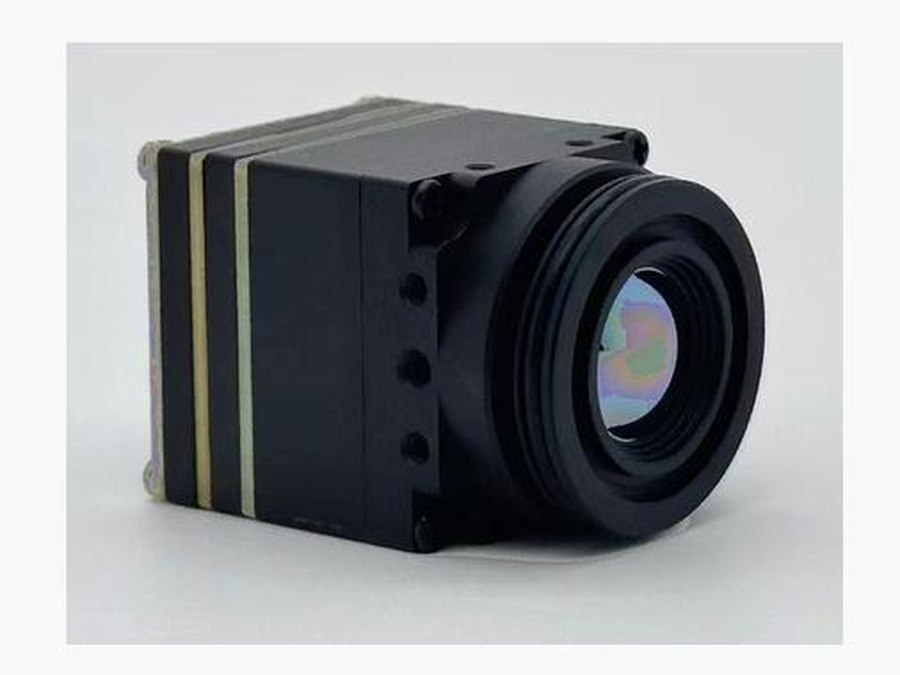
A full image chain on the core — correction, brightness and contrast, enhancement, denoise, digital zoom, mirror, Gamma and colour palette — streamed as standard UVC video and controlled over a CDC virtual COM port. Supplied with InfraredControl software.
| Detector | UFPA (VOx) uncooled focal plane array |
|---|---|
| Resolution | 640 (H) × 512 (V) · 12 µm pitch |
| Spectral band | 8–14 µm (LWIR) |
| Frame rate · NETD | 50 Hz · ≤ 30 mK |
| Video · control | USB UVC (YUY2) · USB CDC virtual COM port |
| Power | USB 5 V · ≤ 0.85 W |
| Lens options | 9.1 / 13.4 / 35 mm — field of view by lens |
| Software | InfraredControl V3.0.5 |
The 640 × 512 array at 12 µm pitch gives an active image area of 7.68 × 6.14 mm. Field of view therefore follows directly from the lens focal length.
| Lens (EFL) | HFOV | VFOV | DFOV | IFOV | Ordering model |
|---|---|---|---|---|---|
| 9.1 mm | 45.8° | 37.3° | 56.8° | 1.32 mrad | CT11-USB-640-9.1 |
| 13.4 mm | 32.0° | 25.8° | 40.3° | 0.90 mrad | CT11-USB-640-13.4 |
| 35 mm | 12.5° | 10.0° | 16.0° | 0.34 mrad | CT11-USB-640-35 |
Nominal values calculated from the detector geometry at F1.0. The delivered figure is confirmed against the actual lens version and test report, and may differ slightly with lens distortion. Assembled weight varies by lens configuration and is quoted per version — ask us for the version you need →
Export control. The CT11-USB incorporates an uncooled microbolometer focal plane array operating above 9 Hz and is subject to export control, including ECCN 6A003 under the U.S. Export Administration Regulations and equivalent national controls of the exporting jurisdiction. Quotation and the release of detailed technical data are subject to receipt of a statement of intended use. Where the unit is resold or transferred onward, sale and shipment are additionally subject to receipt of acceptable end-user details, and to any export licence required. Re-export and re-transfer are subject to the same controls.
640×512 LWIR resolution resolves people, animals and heat signatures in complete darkness.
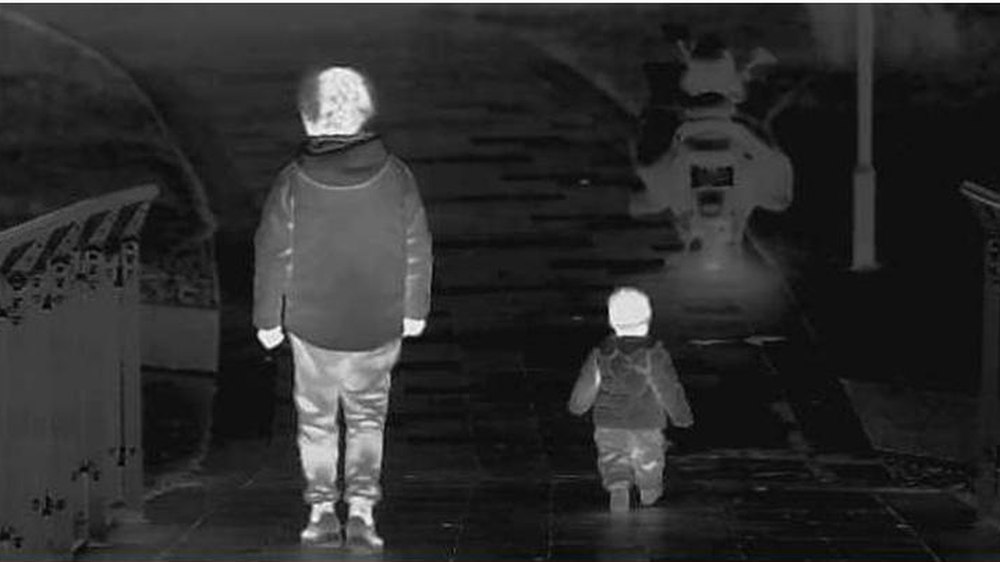
CT11-USB infrared imagery — outdoor pedestrian scene, no visible light.
Heat is a leading indicator. A fault warms up before it trips, seizes or leaks — which is why a fixed thermal core earns its place in civil and industrial infrastructure.
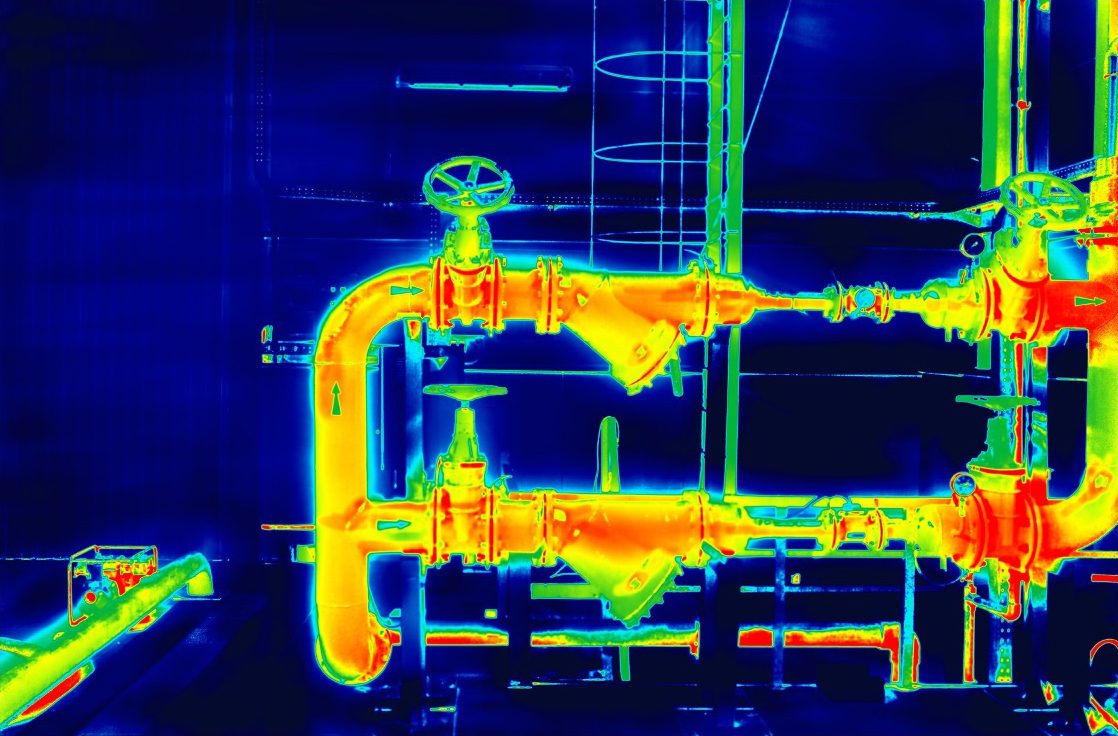
A loose or oxidising connection heats long before it fails. A fixed core watches the panel continuously, instead of an annual infrared survey that misses everything in between — and it reads the board without a door being opened.
Conveyor drives, pumps, fans and gearboxes announce a fault as a rising temperature. Trend the reading and a bearing becomes a planned work order rather than an unplanned stoppage.
Hot lines, cold lines, blocked traps, failing lagging and liquid level in a tank all separate on temperature — through insulation, and without contact.
Missing insulation, moisture ingress, underfloor heating runs and HVAC performance. Thermal turns an invisible building fault into something you can point a maintenance team at.
Darkness, fog, smoke and low sun blind an optical camera. They do not affect a thermal core, which reads emitted heat — so a perimeter, a yard or a level crossing stays observable around the clock.
Wayside bearing and brake temperature, station and tunnel plant, parking structures and airfield ground equipment — assets that are linear, unpowered and expensive to visit.
The CT11-USB is a camera core, not a finished instrument. It is intended for integration into an OEM product, an embedded system or a fixed monitoring installation. It is not a medical device and is not intended for human temperature screening or for any life-safety or fire-detection function.
Streams as a standard USB Video Class device (YUY2) — no proprietary capture card, works with off-the-shelf pipelines.
A USB CDC virtual COM port carries all commands — palette, zoom, enhancement and correction — on the same cable as the video.
On-core correction, brightness/contrast, denoise, digital zoom, mirror and Gamma, driven by the InfraredControl V3.0.5 software.
The CT11-USB is assembled, calibrated and tested in Taiwan, and a certificate of origin stating Taiwan can be issued for the completed core on request.
A certificate of origin records where a product was last substantially transformed. It does not state the origin of every component, and we do not present it as doing so. For component-level country of origin, for procurement and trade-compliance review, contact us.
Beyond those two things we make no origin claim — not on domestic content, and not on compliance with any particular procurement restriction. If your programme carries a specific country-of-origin, domestic-content or supply-chain requirement, tell us which standard applies and we will tell you in writing where the product stands against it — before you design it in, not after.
Lens selection, image tuning and volume supply — talk to our engineering team.
Part numbers & pricing → Talk to an engineer Back to FLSEMI