
A PoE-powered DIN-rail gateway that receives Bluetooth LE telegrams from battery-free switches and sensors and delivers them as JSON over UDP (IPv4 and/or IPv6) or a TCP feed — no broker, no cloud. A built-in live dashboard at http://bfi53er0-xxxx.local/ — the name printed on the label — shows every device as it is heard; settings are password-protected and answer the local network only. In the same DIN-rail box: a Modbus gateway, field I/O and microSD logging — one gateway instead of several.
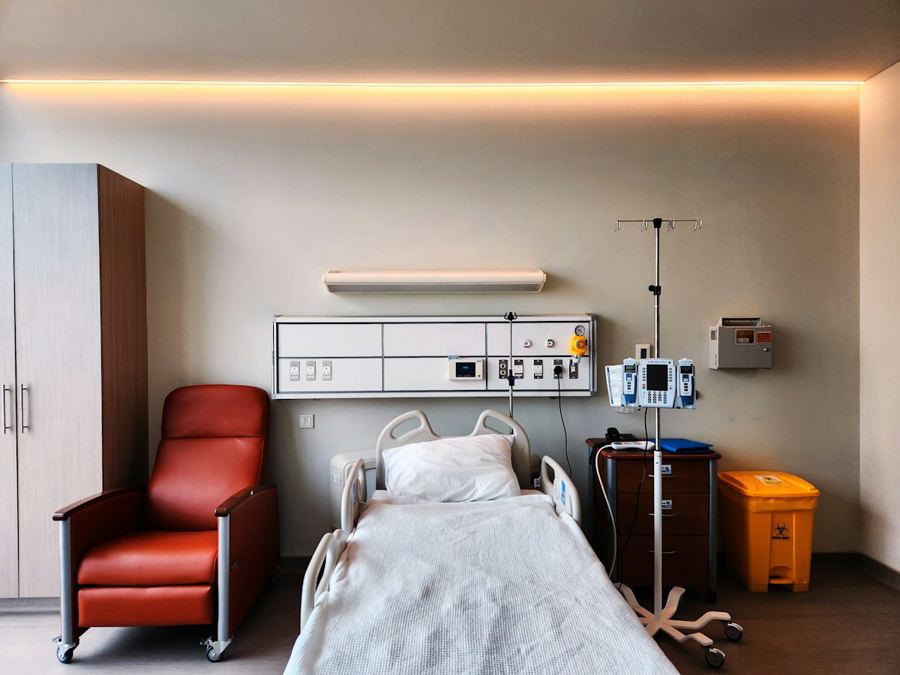
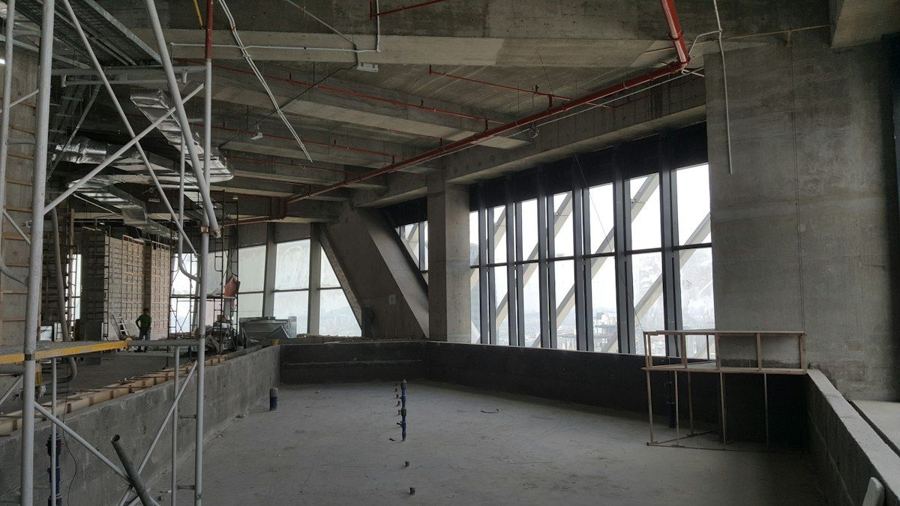
Used in: Assistive Help Call for Care, Healthcare & Schools · Factories & Infrastructure · Commercial Buildings & Hotels
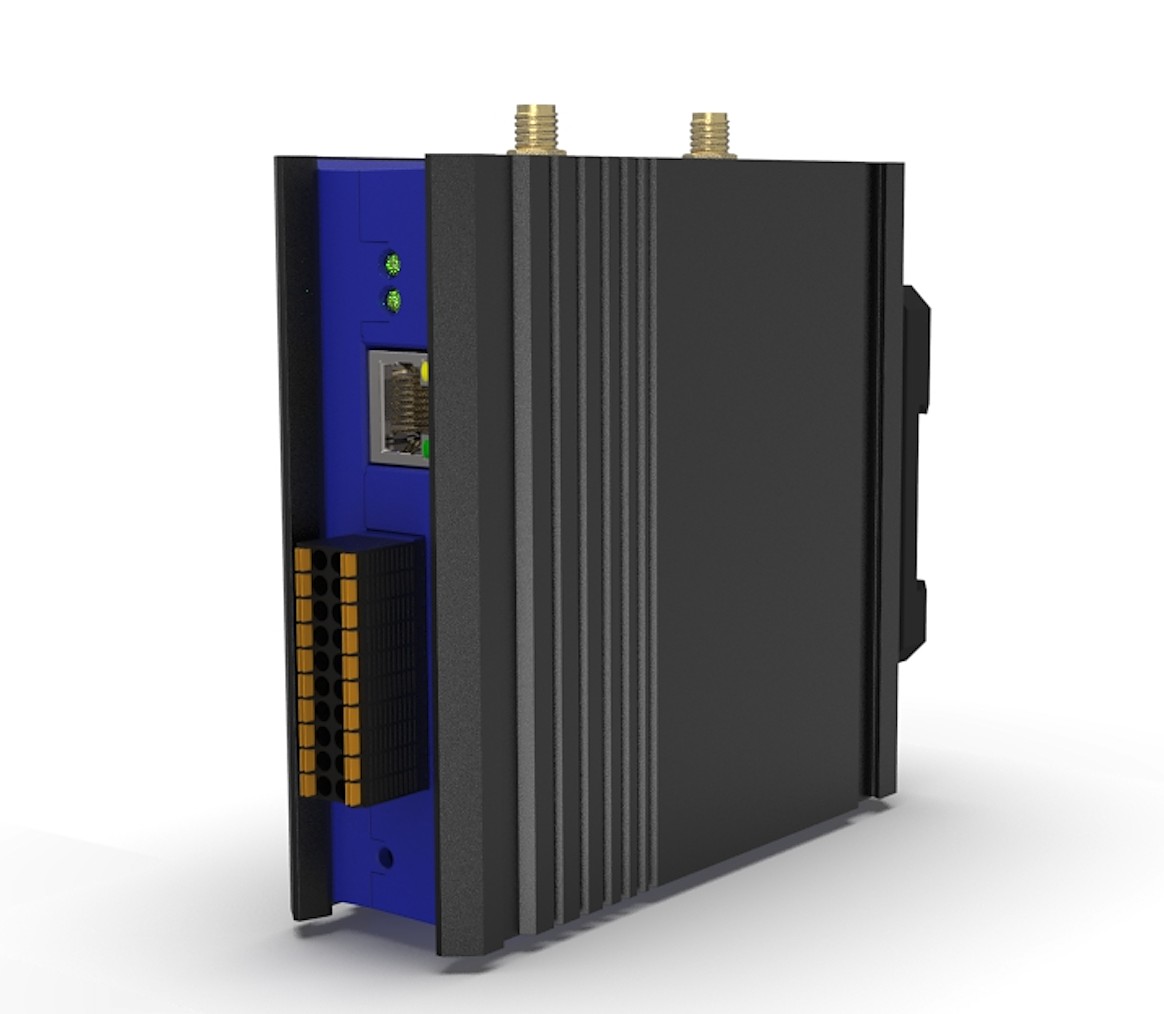 Rendering. Production enclosure is black-plated extruded aluminium.

The gateway listens on the three Bluetooth advertising channels all the time, merges the copies of each telegram into one, and forwards it with the signal strength and a count of any telegrams from that device that never arrived. It holds no device keys: decoding and authentication belong with the system that consumes the telegrams.
http://bfi53er0-xxxx.local/ — the name printed on the label; no address needednc, PythonThe PLC or SCADA reads the battery-free devices as ordinary Modbus registers, talks to RS-485 equipment through the gateway, and drives the terminals — no packet decoding, no second box. Figures measured on a bench unit, firmware 0.57.82. The register blocks in outline are in the Quick Start, chapter 5; the complete register map is in the System Integration Guide, leave your details to get it.
On the Rules page you choose a switch or a sensor, say what each of its events does, and tick the outputs it works. The gateway does the rest by itself.
| Application | Rules per group | How many groups |
|---|---|---|
| Roller blind or shutter with dry-contact inputs (up / stop / down) | 3 | up to 21 — or 20, plus one group that sends all of them up, stops or lowers them together |
| Two-wire roller motor (up / down; stop = both off) | 2 | up to 32 |
| Lights or loads, each switched by one switch or sensor | 1 | up to 48 (the device list) |
| Alerts from door contacts and occupancy sensors | 1 | up to 48 (the device list) |
These are the firmware’s configuration limits (BFi53ER0-BF, firmware 0.57.96 and later), not measurements with a particular motor or load. A group may be one motor, or several wired in parallel as their maker allows. Motor inputs that need dry contacts are driven from relay modules on the RS-485 bus, not from the open-collector digital outputs; a two-wire motor needs an interlock in its wiring or controller. How many modules one RS-485 segment carries depends on their unit loads. BFi53ER0 only; BFi53ER0S terminal assignment to be announced. Full table in the hardware specification v2.9, section 4.4. Wiring examples — the RS-485 bus, a dry-contact roller blind (up / stop / down), a two-wire motor behind an interlock, and a digital output driving a 24 V relay — are in the User Manual, section 11.9; the roller examples have not yet been tried with a motor.
An alert, not a certified alarm system. A radio telegram can be missed and the 2.4 GHz band can be jammed; the gateway is not approved as an intruder or safety alarm, so do not rely on it where life or property depends on it. Battery-free telegrams carry no signature: where it matters, arm and disarm from the settings page or over Modbus, not with a battery-free switch. Details are in the User Manual.
From a Mac terminal. Every gateway’s name starts with bfi53er0- and matches its label.
# list the gateways on this network
dns-sd -B _http._tcp
# check that one is online — it answers {"ok":true,…}
curl http://bfi53er0-xxxx.local/api/title
The live view shows a card for every device as the gateway hears it, decoded in the browser. The settings page, behind the password, chooses where telegrams go and which devices are forwarded.
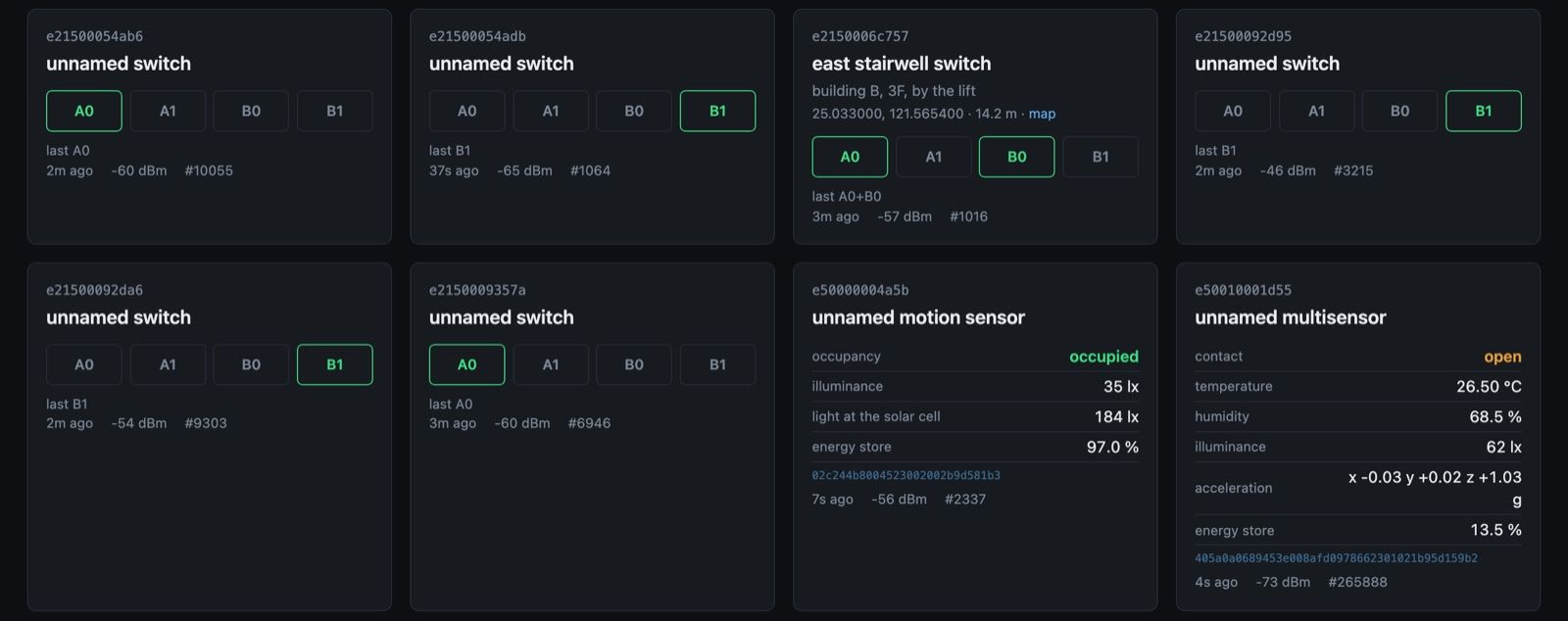
http://bfi53er0-xxxx.local/, from a working gateway: wall switches with the contact last pressed, an EMDCB motion sensor and STM 550B multisensors, each with signal strength and sequence number.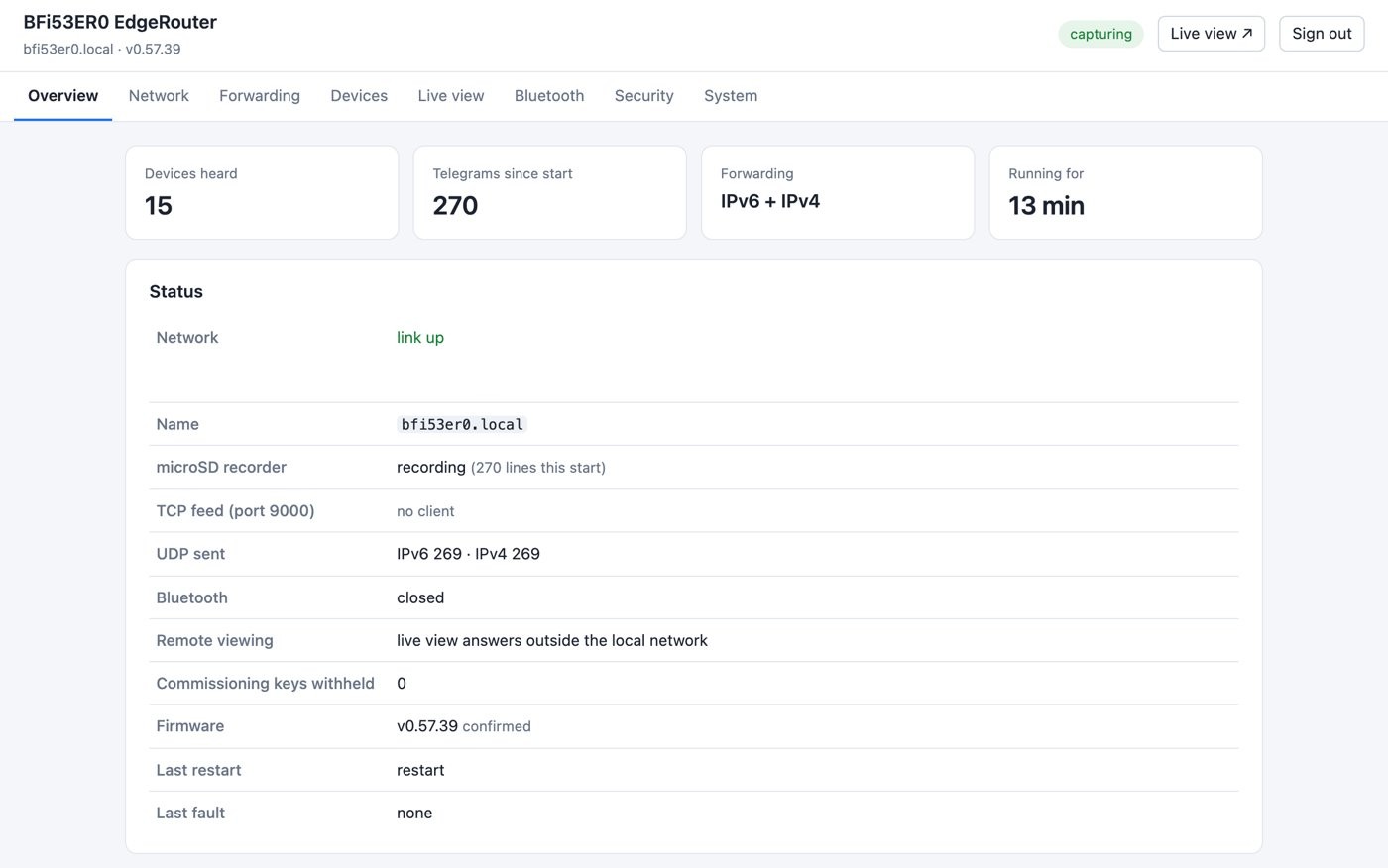
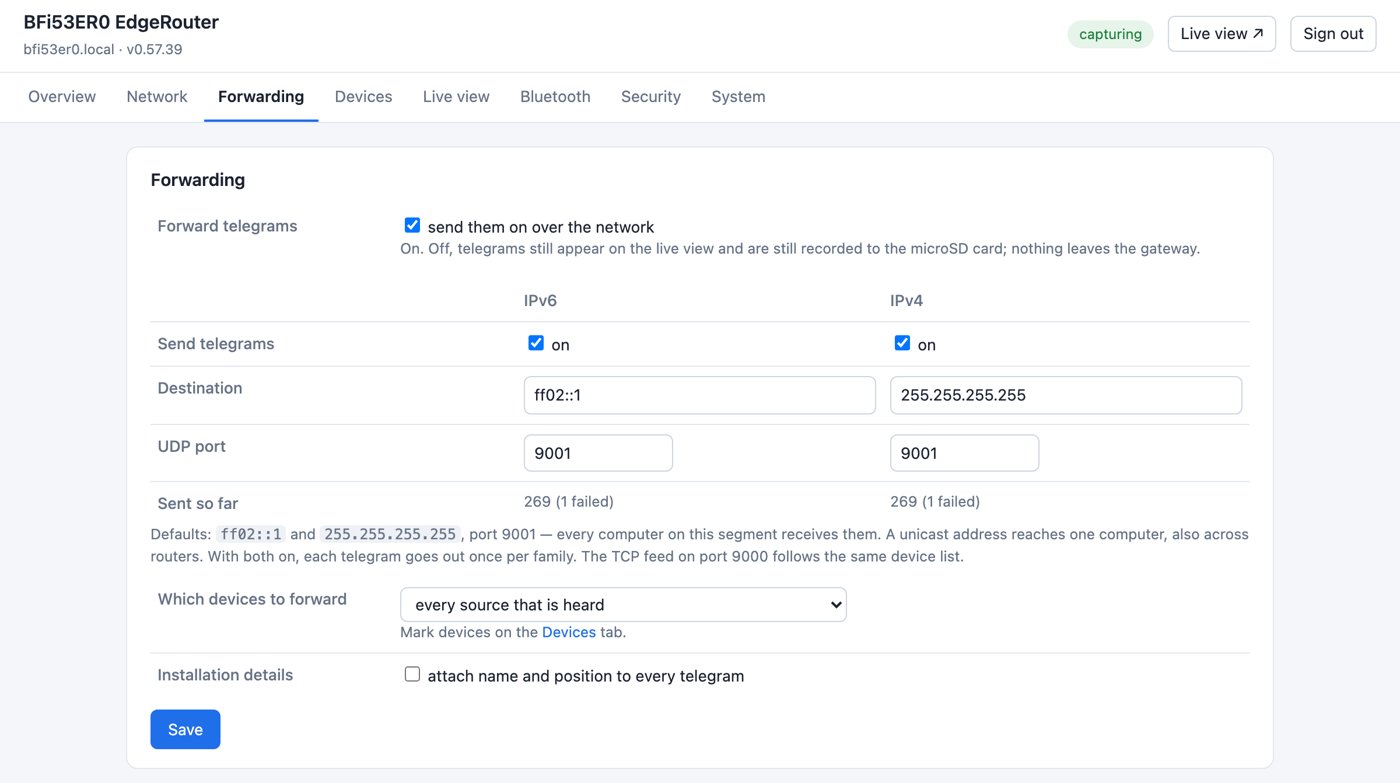
ff02::1 and 255.255.255.255 on port 9001, reach every computer on the segment with nothing configured.These harvest their energy from a press, from light or from motion, and need no battery. Most are EnOcean’s — a long-standing partner whose Bluetooth energy-harvesting devices this gateway is built around. The gateway forwards every EnOcean Bluetooth LE telegram it hears; the devices below have been captured on the bench — the EMSIB is the same STM 550B in a frame.
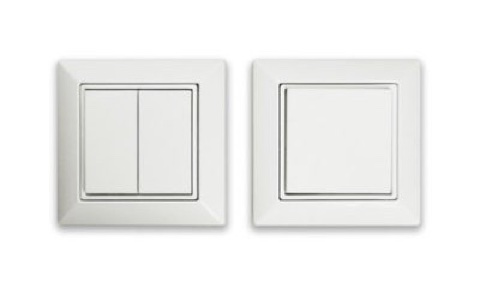
Kinetic wall switch — the press powers the telegram. Single rocker (2 channels) or double rocker (4 channels).
Reports contact A0, A1, B0 or B1; press or release
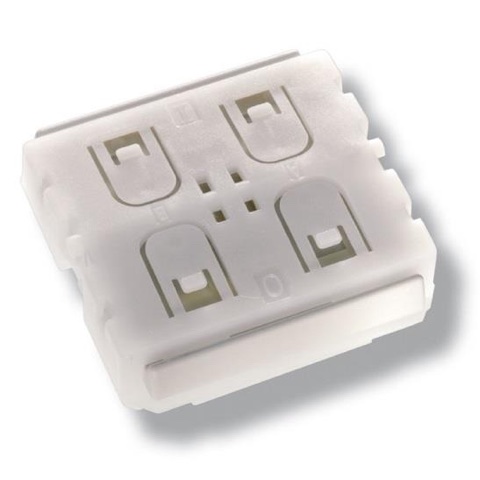
The same transmitter as a module, for switch makers building their own rocker and frame.
Reports the same telegrams as the finished switch
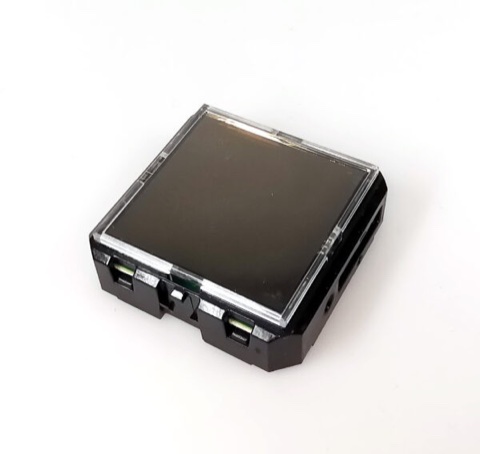
Solar-powered multisensor, sending on a schedule and on change.
Factory-calibrated: EnOcean stores the calibration values inside the sensor, so there is nothing to adjust on site — ±0.3 K, ±3 % r.h., light ±10 % per EnOcean.
Reports temperature, humidity, illuminance, acceleration, magnet contact, energy store
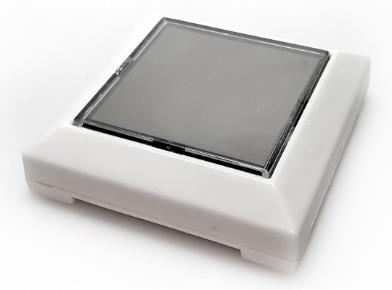
The STM 550B with an Easyfit frame around it — the same module, ready to mount.
Reports the same telegrams as the STM 550B
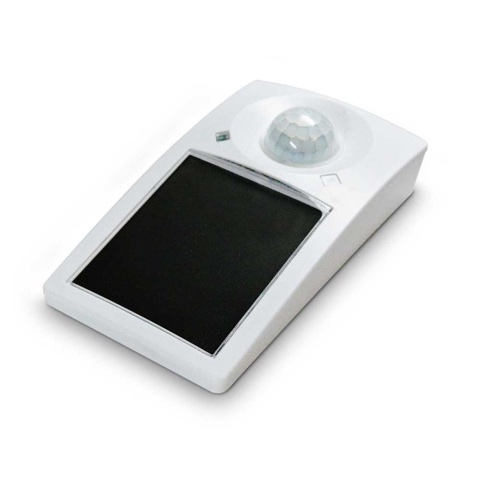
Solar-powered ceiling-mount occupancy sensor.
Factory-calibrated light sensing: EnOcean calibrates the solar cell at the factory and keeps the values in the sensor — ±5 % at full scale. Light on a desk surface still needs calibrating at the receiver.
Reports occupancy, illuminance, light at the solar cell, energy store
Product photos: EnOcean GmbH. Calibration and accuracy: EnOcean STM 550B user manual v1.5 (2023) and EMDCB user manual v1.8 (2021).
Bluetooth only. The gateway listens at 2.4 GHz. EnOcean’s 868 / 902 / 928 MHz products are a different radio and are not received.
Press, push in, plug in, pull out — the mechanical action itself is the power supply. An EnOcean kinetic harvester turns one movement into enough energy for one authenticated Bluetooth LE telegram, and the gateway collects it, merges the copies, adds signal strength and a missed-telegram count, and hands it to your network. No battery to change, no wire to run.
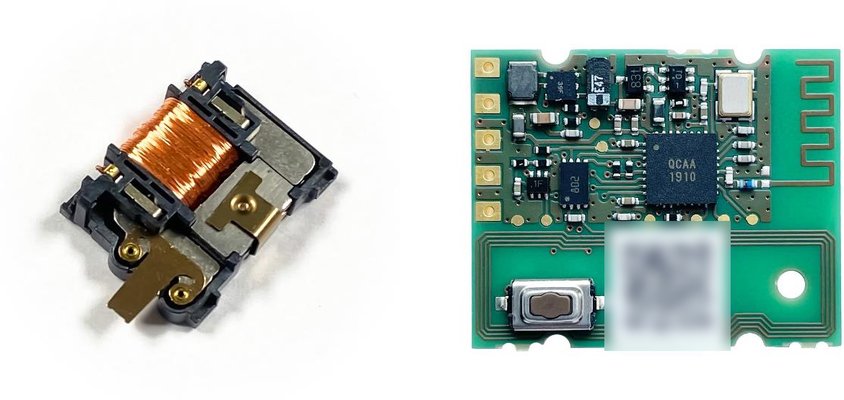
EnOcean’s newest kinetic harvester and Bluetooth LE transmitter.
With the gateway Received on the bench as a single-key OneKey switch (firmware 0.57.42); EnOcean’s datasheet gives the same Bluetooth LE encoding as the PTM 215B, with AES-128 authentication and a sequence counter. On the BFi53ER0-BF the same press also appears as Modbus registers, or drives a terminal output directly.
Integration. EnOcean rates the PTM 535BZ for indoor use in dry rooms (−25 to +65 °C) and the ECO 260 for 0 to +40 °C (−25 to +65 °C under evaluation). Outdoor vehicles need a sealed housing and temperature and vibration qualification, and a metal airframe changes the radio range — measure on the actual vehicle. For a larger site, several collection points can report back over a DECT NR+ mesh through the BFi53ER0S; that is an architecture proposal, verified per project. Housing, mechanics and collector integration are available as engineering services.
Photos and figures: EnOcean GmbH — ECO 260 datasheet (March 2023) and PTM 535BZ datasheet (product preview, May 2021).
Battery-free call buttons, plus the factory-calibrated STM 550B and EMDCB for room climate, presence and light — collected by one BFi53ER0 and handed to the nurse-call, security or building system. For long-term care homes, hospitals and clinics, kindergartens, schools and public places.
Figures from a working unit on the bench, except where marked as a planning figure.
| Heard → handed to the network | 46 ms on average, measured (firmware 0.57.43). Each telegram first waits for its repeat copies — 44 ms on average, 61 ms at most measured — so it goes out once, with the count of copies; the live view does not wait |
|---|---|
| Delivery | 19 of 19 telegrams arrived on both IPv4 and IPv6; 24 telegrams in two rapid bursts, none missing |
| TCP feed catch-up | 22 of 22 telegrams missed during a disconnection delivered on reconnect, in order (microSD fitted) |
| Live view | Shows each telegram the moment it is heard, ahead of UDP and TCP |
| Web pages, served compressed | Live view 6.9 KB in 20 ms; settings pages 12.9 KB in 32 ms |
| Modbus | Up to 32 Modbus TCP masters at once, about 400 requests/s shared evenly, no errors; a cached RS-485 read answers in about 2 ms, against about 43 ms reading through to the bus at 9600 bit/s (firmware 0.57.82) |
| Devices per gateway | 256 sources tracked at once is a planning figure: when the table is full, the source heard longest ago gives up its slot, so no device is refused. Up to 48 of them named, placed and on an allow or block list is a firmware limit — the device table has exactly 48 entries. Both are set by the firmware’s tables; radio coverage and other 2.4 GHz traffic on the site usually limit first. |
The light breathes one colour for the gateway’s state, most urgent first; the first that applies is shown. At power-up it checks each colour — red, green, blue, white, 1.2 s each — unless the light is switched off. Brightness is set from 0 to 100 %, or off, on the settings page; the update colours (magenta, and magenta / white) always show, at no less than 25 %. BFi53ER0-BF firmware.
| Colour | Breath | Meaning |
|---|---|---|
| White | 1.2 s | Starting |
| Magenta | 0.7 s | Firmware being written — do not remove power |
| Magenta / white, fast | 0.25 s each | Firmware being written from the microSD card at start — do not remove power |
| Green, fast | 0.5 s | For 15 s: password or all settings reset with the reset button |
| Magenta / white, slow | 1 s each | The image from the microSD card on trial; it keeps itself after 2 minutes — do not remove power |
| Red | 3 s | No network address |
| Blue, fast | 1 s | Bluetooth open for a firmware update |
| Amber | 3 s | Capturing; microSD recorder off (no card, or the card failed) |
| Cyan | 4 s | Capturing and recording, and a TCP feed client is connected |
| Blue | 4 s | Capturing and recording |
| Green flash | 0.2 s, once | A telegram was heard (over any state) |
Runs on either model, powered by PoE+ or 14–32 V DC, DIN-rail or wall mount. Field interfaces on the BFi53ER0 terminal block: RS-485, two 0–10 V analog inputs and outputs, four digital outputs and two digital inputs. BFi53ER0S: terminal assignment to be announced. Made in Taiwan by BANFi Semiconductor.
What the gateway does, a first installation, the status light, the live view, and integration at a glance — ports and the Modbus register blocks in outline.
BFi53ER0-BF firmware 0.57.82 · v1.8 · 9 pages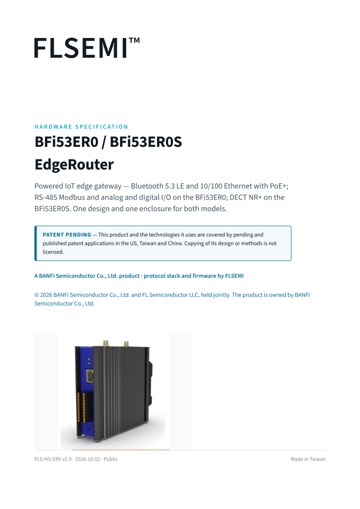
BFi53ER0 / BFi53ER0S: block diagram, terminal layout, SWD debug header, electrical, mechanical, certification and ordering.
FLS-HS-ER0 v3.2 · 11 pagesReceive every telegram over UDP, read the TCP feed with catch-up, and make a first Modbus TCP read — standard library only, free to use, copy and modify for BFi53ER0 integration.
3 programs + README · v1.1Tell us which devices and how many, what should receive the telegrams, and which Modbus masters or RS-485 equipment are on the site. We will send the product specification and arrange a unit.
BFi53ER0 and BFi53MLG are products of BANFi Semiconductor Co., Ltd. (Taiwan); FL Semiconductor LLC is the point of contact in North America. EnOcean, PTM, STM and Easyfit are trademarks of EnOcean GmbH. Bluetooth is a trademark of Bluetooth SIG, Inc. Modbus is a registered trademark of Schneider Electric, licensed to the Modbus Organization, Inc. Nordic Semiconductor, nRF5340, Arm, Cortex, TrustZone and CryptoCell are trademarks of their respective owners.